

Why Pre-Mixed 3-in-1 Peptides Aren’t as Great as They Sound
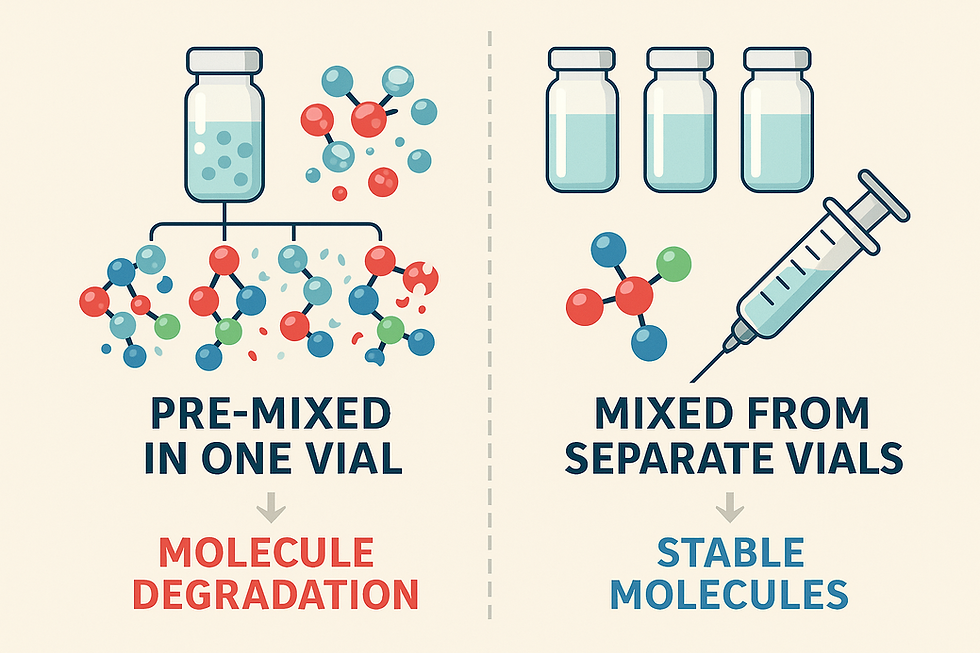
In the age of convenience, everyone wants the magic vial. A “Glow Mix,” a “Wolverine Stack,” or some pre-blended 3-in-1 miracle that promises regeneration, beauty, and fat loss in one tiny bottle. It sounds perfect… until you dig into the actual biochemistry behind how peptides work.
Let’s break down why two peptides in a vial is usually fine, but three or more in the same bottle? That’s often where potency, accuracy, and stability start to fall apart.
✅ Two Peptides in a Vial Is Usually Safe — Here’s Why
When a lab knows what it’s doing, combining two compatible peptides in a single vial can be stable and effective.
Classic examples include:
CJC-1295 + Ipamorelin (GH axis synergy)
TB-500 + BPC-157 (repair-focused, relatively pH-compatible)
As long as:
The peptides don’t have conflicting pH or ionic preferences
They share similar storage requirements
The lab tests the final compound, not just the raw materials
There's no reactive metal ion (like copper) involved
Then two-peptide mixes can be pharmaceutically elegant.
⚠️ Three or More Peptides in One Vial: Where It Breaks Down
Adding a third peptide introduces significant complexity:
Stability Mismatch –Each peptide has a preferred pH, solubility window, and half-life. Mixing 3 increases the chance one will degrade faster or precipitate out.
Oxidative Reactions –Peptides like GHK-Cu introduce copper ions, which can oxidize other peptides (especially thiol or methionine-containing ones), breaking bonds and denaturing structure.
Loss of Dosing Flexibility –You can’t scale or pulse one peptide in the mix without affecting the others. Need more BPC-157 for gut repair but not more TB-500? Too bad.
Injection Volume Math Gets Ugly –Differing optimal doses per peptide mean you either underdose one or overdose another—or inject more fluid than necessary.
Aggregation Risk –Certain peptides clump or misfold when exposed to others in solution over time. This creates inconsistent activity and may even increase immune risk.
💡 The Better Approach: Mix in the Syringe
Here’s what advanced researchers do:
Keep peptides in individual vials, each stored at their optimal concentration
Use a single insulin syringe to draw the desired dose from each vial
Inject the blended dose immediately, avoiding long-term mixing instability
This preserves:
Full potency of each peptide
Flexible protocol control (cycle one off, double another)
Reduced risk of molecular breakdown in storage
More accurate self-titration during research
It's not quite as “plug-and-play,” but it's far more precise—and when it comes to peptides, precision = results.
🔬 Real-World Example:
Let’s say you're building a “Glow Protocol” with:
GHK-Cu (anti-aging, hair, collagen)
Epithalon (circadian & telomere)
MOTS-c (metabolism + mitochondrial function)
All three sound great… but:
GHK-Cu is oxidative and pH-sensitive
Epithalon prefers neutral buffers
MOTS-c is highly unstable after a few hours once reconstituted
Put them in one vial? You’re risking loss of activity before you even inject. Mix them fresh in the same syringe? You bypass the degradation window and get max effect.
🧠 Final Word
The convenience of a 3-in-1 mix is tempting—but for researchers who care about outcomes, individual vials mixed at the point of injection will always be superior. You preserve the science. You protect the signal. And you keep control of your protocol.
Stack smart. Research clean. Respect the molecule.
References:
Manning MC, Chou DK, Murphy BM, Payne RW, Katayama DS. 2010. Pharm Res. 27(4):544–575. doi:10.1007/s11095-009-0044-3
Nugrahadi PP, Hinrichs WLJ, Frijlink HW, Schöneich C, Avanti C. 2023. Pharmaceutics. 15(3):935. doi:10.3390/pharmaceutics15030935
Slingluff CL, Petroni GR, Yamshchikov GV, Barnd DL, Eastham S, Galavotti H, Patterson JW, Deacon DH, Grosh WW. 2009. Clin Cancer Res. 15(22):7161–7170. doi:10.1158/1078-0432.CCR-09-1024
Wang W, Singh S, Zeng DL, King K, Nema S. 2007. J Pharm Sci. 96(3):646–674. doi:10.1002/jps.20974
Wang L, Wang N, Zhang W, Cheng H, Lu Q, Yang B, Zhou H, Zhang H. 2022. Signal Transduct Target Ther. 7(1):48. doi:10.1038/s41392-022-00904-4
Zhang Y, Wang Y, Li X. 2023. ACS Pharmacol Transl Sci. 6(3):203–212. doi:10.1021/acsptsci.4c00503
Li J, Mooney DJ. 2016. Nat Rev Drug Discov. 15(4):261–279. doi:10.1038/nrd.2015.6
Liu J, Wang Y, Wang Y. 2015. PLoS One. 10(7):e0134427. doi:10.1371/journal.pone.0134427
Rader RA. 2008. Nat Biotechnol. 26(7):743–751. doi:10.1038/nbt0708-743
Fosgerau K, Hoffmann T. 2015. Drug Discov Today. 20(1):122–128. doi:10.1016/j.drudis.2014.10.003


Comments